

- info@a-squaredalarms.com

Most schools and public venues believe they have solid emergency procedures in place — written lockdown protocols, evacuation routes, staff responsibilities and regular drills. But even the most carefully designed plan can fail if one essential element is missing: rapid, reliable internal communication. In an emergency, the ability to deliver clear instructions to staff within seconds can determine how effectively a situation is managed and how safely people respond.
Many venues underestimate the complexity of communication during high-stress incidents. Noise, confusion, panic and physical distance between staff members all make it difficult to rely on traditional tools like emails, walkie-talkies or verbal messaging. This gap becomes even more critical under Martyn’s Law, which places strong emphasis on preparedness and coordinated action.
The majority of communication issues during emergencies stem from slow or unreliable systems. Emails may go unread or take too long to deliver. Radios require every staff member to be tuned in and paying attention, and they often suffer from interference or dead spots inside large buildings. Alarm systems can warn that something is wrong, but they do not provide instructions — leaving staff unsure whether to evacuate, lock down or shelter in place. Runners or verbal relays are even slower, inconsistent and potentially dangerous.
In a real emergency, speed matters. Seconds matter. A message that reaches some staff but not others can create inconsistent responses, panic or bottlenecks. Without a solution that reaches everyone instantly and unambiguously, even well-intentioned plans fall apart.
True emergency readiness is not just about having a written procedure — it is about ensuring that every staff member receives the same clear instruction at the same moment. Internal communication becomes the backbone of a coordinated response. When staff are informed instantly, they act faster, make better decisions and help protect the people in their care.
This is especially important in schools, where teachers may be isolated in classrooms or unaware of developments happening in other areas. In public venues, teams may be spread across large spaces where verbal or radio communication cannot reach quickly enough. Without a site-wide alert system, staff cannot take correct, unified action.
Digital internal alert systems have become the missing link in emergency planning. Unlike outdated methods, these systems deliver instant, full-screen alerts across all staff devices, ensuring no one misses the message. They remove guesswork and provide clear, written instructions that guide staff on exactly what to do.
This technology aligns perfectly with the expectations of Martyn’s Law, which requires venues to demonstrate meaningful readiness, staff awareness and reliable communication processes. An emergency plan without a strong communication method is no longer sufficient.
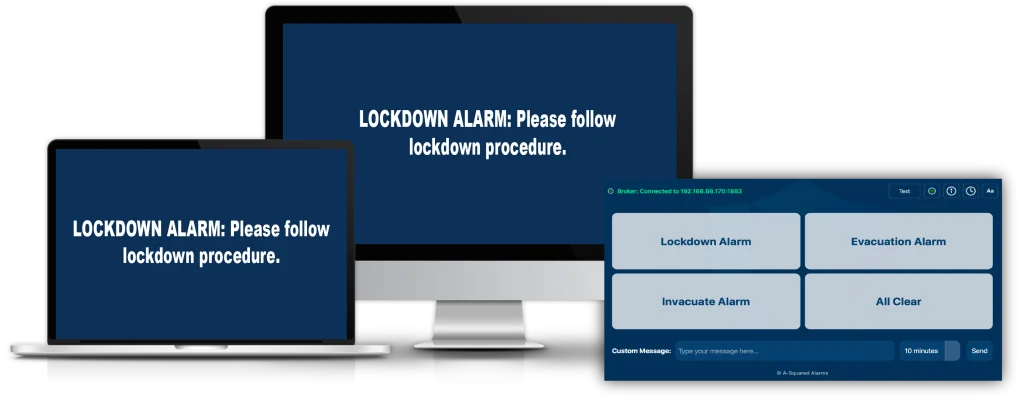
PopAlert is designed specifically to deliver fast, unavoidable internal alerts across schools and public venues. Its full-screen messaging ensures staff receive instant instructions, with no delays, no missed notifications and no reliance on cloud services or mobile networks. Because PopAlert runs on-premises, it remains operational even during connectivity issues — a critical factor in emergency scenarios.
PopAlert supports multiple alert types, including lockdown, evacuation, invacuation and custom instructions, allowing venues to guide staff based on the specific situation. It also integrates with physical triggers, panic buttons and third-party systems like Alertex, providing complete internal and external coverage.
Installation requires no building work or complex infrastructure, making it one of the simplest and most cost-effective upgrades a school or venue can implement. Once installed, PopAlert becomes a key part of staff training, emergency drills and compliance documentation — helping organisations meet the communication expectations outlined in Martyn’s Law.
Organisations should not wait for legislation to take effect before strengthening their communication capabilities. Emergencies are unpredictable, and venues that can deliver fast, consistent instructions are significantly better prepared. Communication failures are one of the most common and most dangerous weaknesses in emergency planning — but they are also among the easiest to fix with the right technology.
PopAlert ensures that every staff member receives the same instruction in the same moment, creating calm, coordinated and effective responses. When communication is strong, every other part of the emergency plan becomes stronger.
Internal communication is often the forgotten piece of emergency planning, but it is arguably the most important. Without a rapid and reliable way to notify staff, even the best-written procedures fall apart under pressure. PopAlert® provides the instant, site-wide communication system schools and venues need to protect staff, pupils and visitors — and to meet the expectations of modern safety legislation, including Martyn’s Law.
If your organisation wants to eliminate communication gaps and upgrade its emergency readiness, we can help you install PopAlert, train your staff and build a stronger, safer response framework. Book a demo today and take the first step toward complete emergency preparedness.